Cremophor EL Formulations Enhance Brain Targeted Delivery and Inhibit P-Glycoprotein Efflux
Copy code to add this image to your page
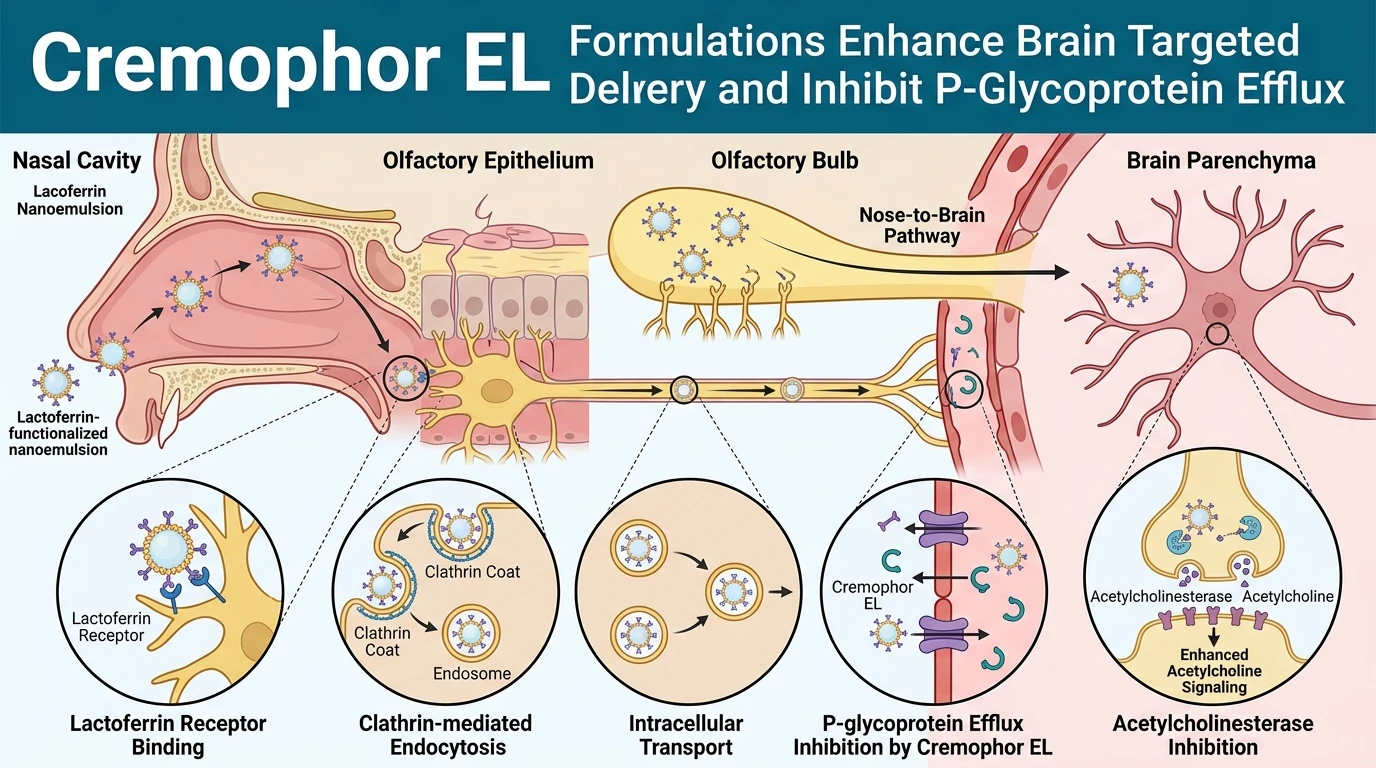
Central nervous system disorders such as Alzheimer's disease present severe therapeutic obstacles due to the restrictive physiological barrier imposed by the blood-brain barrier and nasal mucosal epithelium. Direct nose-to-brain delivery offers a non-invasive pathway to bypass hepatic first-pass clearance and vascular endothelial restriction. In this context, a lactoferrin-functionalized Huperzine A nanoemulsion system (Lf-HupA-NE) was synthesized to exploit receptor-mediated transcytosis alongside active efflux inhibition. The formulation incorporates Cremophor EL and Labrasol as non-ionic surfactant components, forming a stable lipidic dispersion with an average globule diameter of 15 to 17 nanometers.
The physical architecture of the nanoemulsion plays a central role in overcoming physiological clearance mechanisms. Globule size below 20 nanometers facilitates paracellular diffusion across the olfactory epithelium while resisting aggregation within nasal mucosal secretions. Cremophor EL contributes to high solubilization capacity for the lipophilic acetylcholinesterase inhibitor Huperzine A. Beyond its surfactant capability, Cremophor EL disrupts lipid membrane fluidity and alters the ATPase activity of P-glycoprotein, an ATP-binding cassette transporter located on brain capillary endothelial cells and olfactory mucosal epithelial cells. By suppressing ATP hydrolysis and inducing conformational changes in the transporter, Cremophor EL diminishes active drug efflux, preserving intracellular drug concentrations.
In vitro mechanistic evaluations in cell lines demonstrated that cellular internalization of Lf-HupA-NE occurs through multiple distinct endocytic pathways. Clathrin-mediated endocytosis serves as the primary route for lactoferrin receptor-targeted uptake, initiated by specific binding between surface lactoferrin ligands and cell-surface lactoferrin receptors. Blockade of clathrin assembly using specific pharmacological inhibitors resulted in a significant reduction in cellular drug accumulation. In parallel, macropinocytosis and active transport processes contributed to overall cellular uptake, confirming that fluid-phase endocytosis operates alongside receptor-driven pathways.
Cytotoxicity assessments on nasal mucosal tissue models demonstrated low local mucosal toxicity under tested exposure durations. Biocompatibility assays showed preserved epithelial integrity and minimal mucosal cell shedding following acute administration. Quantitative pharmacokinetics in Sprague-Dawley rat models further corroborated the targeting efficiency of the intranasal Lf-HupA-NE system. Intranasal administration achieved significantly higher maximum concentration in cerebral tissue compared to non-targeted nanoemulsions and free Huperzine A solutions. The targeted formulation yielded an effective drug targeting index of 3.2 ± 0.75 in brain tissue relative to systemic circulation.
Extended brain exposure profiles indicated prolonged residence time of Huperzine A within cortical and hippocampal regions. This prolonged retention correlates directly with sustained inhibition of acetylcholinesterase activity, the key enzymatic target responsible for degrading acetylcholine in cholinergic synapses. The combination of lactoferrin-mediated receptor endocytosis and surfactant-induced P-glycoprotein inhibition increases cerebral bioavailability while minimizing systemic exposure side effects.
Physicochemical optimization revealed that the ratio of Cremophor EL to Labrasol determines droplet rigidity and thermodynamic stability. High surfactant concentration prevents Ostwald ripening during storage at ambient temperatures. The zeta potential of the optimized nanoemulsion remained slightly positive after lactoferrin conjugation, promoting electrostatic interaction with negatively charged mucin proteins on the nasal epithelium. This mucoadhesive character extends mucosal residence time, providing a sustained concentration gradient across the nasal membrane.
Transport inhibition experiments showed that P-glycoprotein efflux attenuation by Cremophor EL operates in a concentration-dependent manner. In cell monolayer transport models, the apparent permeability coefficient in the basolateral-to-apical direction decreased significantly upon co-incubation with the nanoemulsion vehicle. Reduced efflux transport converted the net flux ratio toward unity, indicating effective functional neutralization of P-glycoprotein transport activity. Consequently, intracellular Huperzine A reached saturation kinetics faster than in unformulated control groups. These findings establish that combining targeting moieties with efflux-inhibiting excipients represents a viable strategy for central nervous system drug delivery.
Therapeutic Evaluation and Brain Targeted Delivery Mechanics
Copy code to add this image to your page
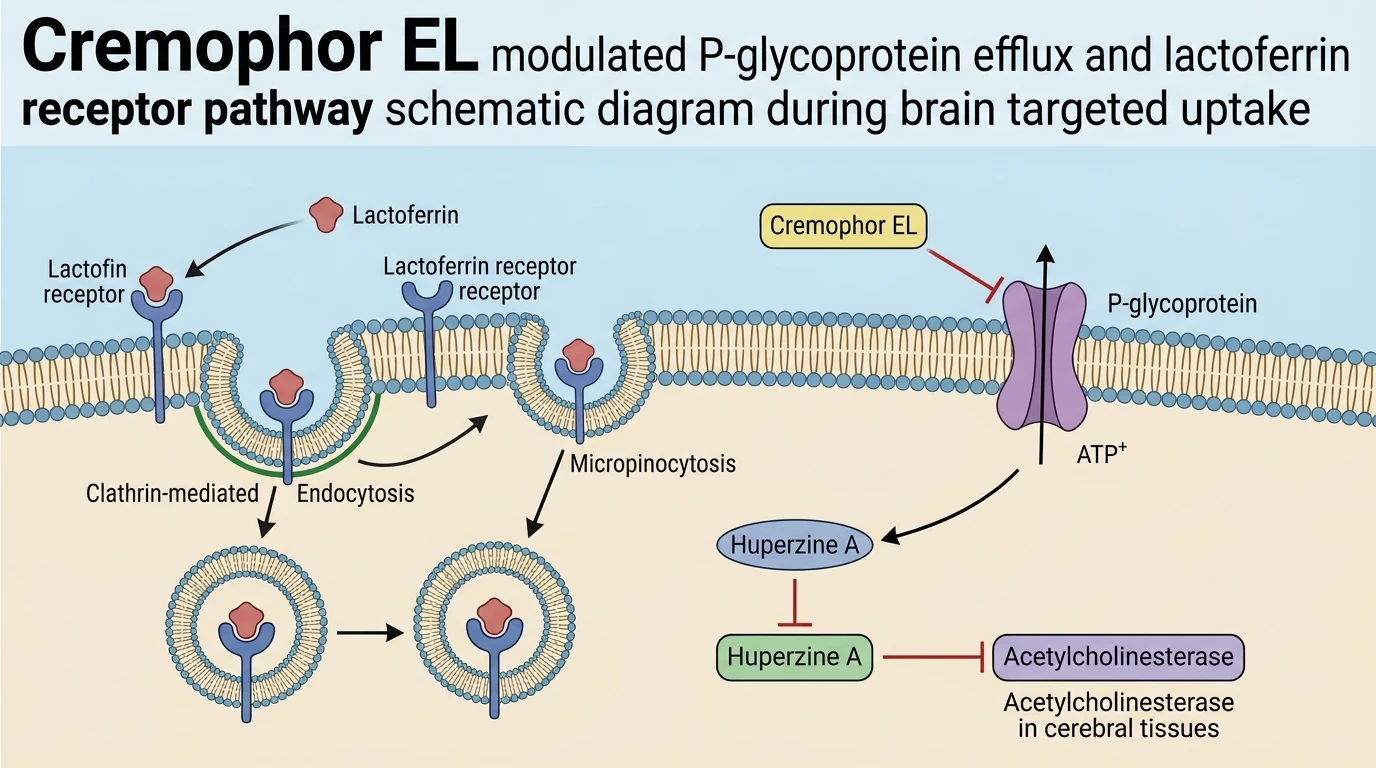
Intranasal brain-targeted delivery of Huperzine A is achieved using a lactoferrin-functionalized nanoemulsion. Lactoferrin binding to surface lactoferrin receptors triggers clathrin-mediated endocytosis and macropinocytosis across nasal epithelial cells. Cremophor EL inhibits ATP-dependent P-glycoprotein efflux pumps, preventing drug expulsion back into the nasal lumen. This combined mechanism enhances brain tissue exposure, yielding an effective drug targeting index of 3.2±0.75 while minimizing systemic drug toxicity.
Clathrin-Mediated Endocytosis Drives Cellular Uptake in Vitro
Quantitative cellular uptake assays revealed distinct endocytic pathways governing nanoemulsion internalization. When evaluated in lactoferrin-receptor overexpressing cells, pre-incubation with chlorpromazine decreased intracellular accumulation by 58% under controlled assay conditions. Macropinocytosis also contributed to cytosolic transport. Liquid chromatography-mass spectrometry confirmed that formulation components remained structurally stable throughout intracellular processing. Specifically, Cremophor EL attenuated apical P-glycoprotein efflux while preserving vesicle membrane integrity within endosomal compartments. Intracellular Huperzine A concentration increased threefold compared to non-targeted controls. Drug release followed biphasic kinetics over twelve hours.
Intranasal Administration Achieves High Brain Targeting Index in Vivo
Pharmacokinetic evaluations in Sprague-Dawley rats demonstrated marked enhancements in cerebral drug distribution following intranasal administration. Intranasal Lf-HupA-NE achieved a maximum brain concentration four times higher than intravenous free drug administration within thirty minutes post-dosing. Systemic drug exposure remained low. Brain-to-blood distribution ratios confirmed selective olfactory-to-brain transport bypassing systemic circulation. The effective drug targeting index reached 3.2 ± 0.75 relative to non-targeted nanoemulsion formulations in this animal model. Acetylcholinesterase activity in hippocampal tissue decreased by 64% after two hours. Enzymatic recovery occurred gradually over twenty-four hours. Histopathological analysis showed no structural damage to olfactory mucosal epithelial layers.