ISRIB (trans-isomer) ISRIB inhibitor eIF2B modulation in stress response
Copy code to add this image to your page
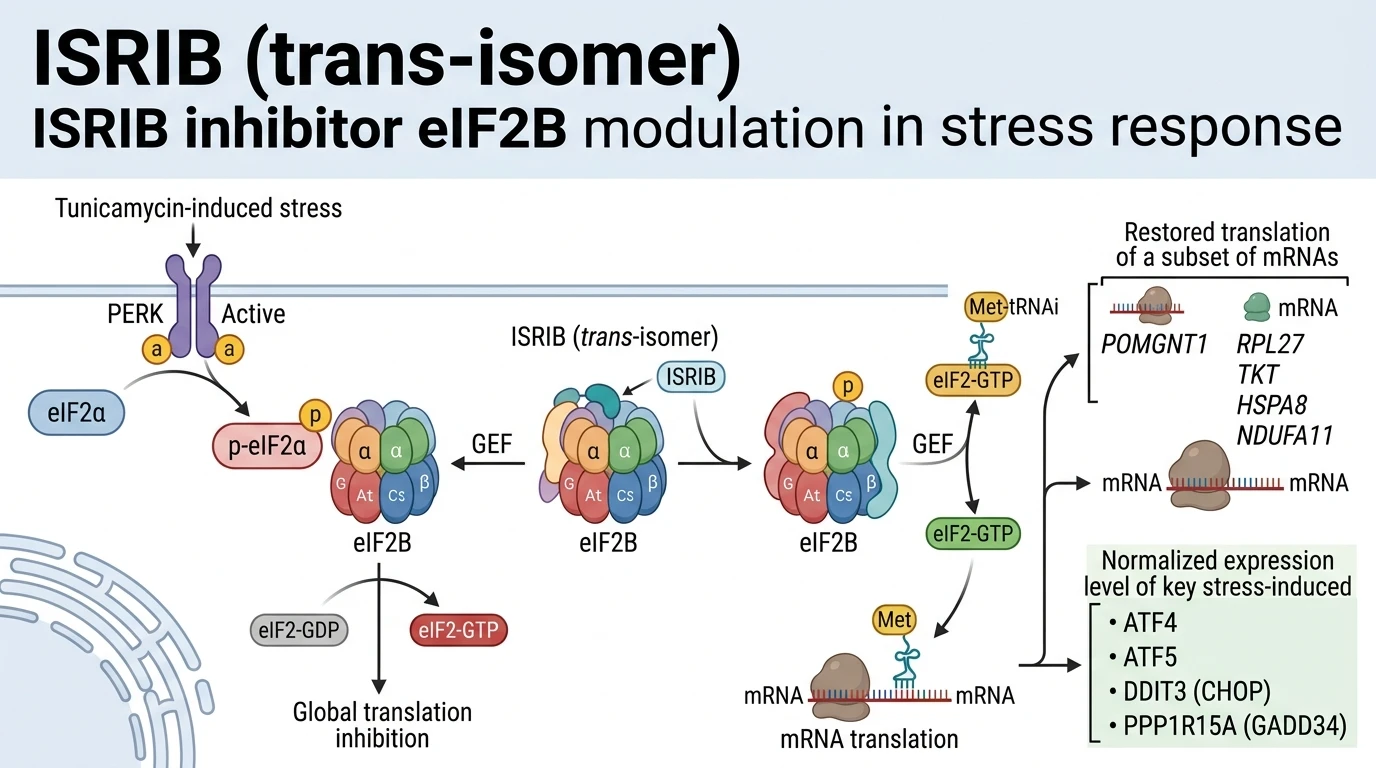
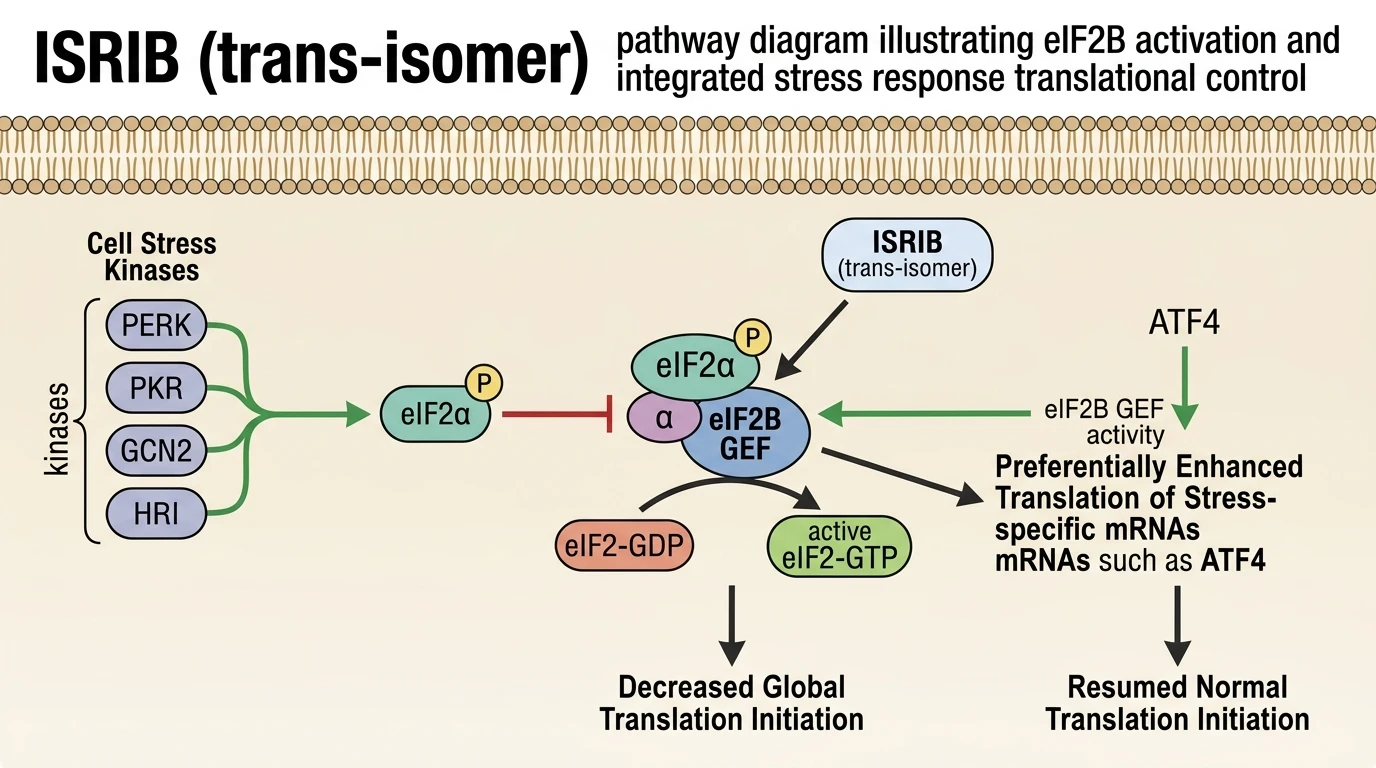
The integrated stress response (ISR) represents a central biochemical signaling network that governs protein synthesis in response to cellular perturbations. Stress conditions such as endoplasmic reticulum (ER) stress, nutrient starvation, heme deficiency, and viral infection activate distinct stress-sensing kinases: PERK (EIF2AK3), PKR (EIF2AK2), GCN2 (EIF2AK4), and HRI (EIF2AK1). Each kinase phosphorylates the serine-51 residue of the alpha subunit of eukaryotic translation initiation factor 2 (eIF2α). In homeostatic states, non-phosphorylated eIF2 forms a ternary complex with GTP and initiator methionyl-tRNA (Met-tRNAi), delivering it to the 40S ribosomal subunit to initiate translation. Exchange of GDP for GTP on eIF2 is catalyzed by eIF2B, a decameric guanine nucleotide exchange factor (GEF) assembled from two heteropentameric complexes consisting of α, β, γ, δ, and ε subunits.
Upon phosphorylation at Ser51, eIF2α binds to eIF2B with significantly higher affinity, turning eIF2α from a substrate into a competitive inhibitor of eIF2B. This competitive binding sequesters eIF2B and limits the abundance of active eIF2-GTP-Met-tRNAi ternary complexes, causing an immediate drop in global protein synthesis initiation. Conversely, low ternary complex concentrations enable ribosomes to bypass upstream open reading frames (uORFs) located within the 5' untranslated regions of specific stress-responsive mRNAs, resulting in the selective translational upregulation of transcription factors such as Activating Transcription Factor 4 (ATF4), ATF5, and DDIT3 (CHOP). Downstream expression of ATF4 further promotes transcription of PPP1R15A (GADD34), which forms a phosphatase complex with PP1 to restore eIF2α dephosphorylation in a delayed negative feedback loop.
To interrogate stress-induced translational dynamics at codon-level resolution, re-analysis of ribosome profiling data was conducted using the specialized computational framework XPRESSyourself. In cell culture models treated with tunicamycin—a nucleoside antibiotic that induces severe ER stress by inhibiting N-linked protein glycosylation—ribosome profiling reveals marked changes in translational efficiency. Tunicamycin treatment leads to widespread ribosomal stalling on canonical housekeeping mRNAs alongside heightened translation of stress-responsive factors.
The small molecule ISRIB (trans-isomer) serves as an exceptionally potent activator of eIF2B, counteracting ISR downstream of eIF2α phosphorylation. Structurally, ISRIB binds to a central hydrophobic cavity formed at the interface of the eIF2B β and δ subunits, acting as a molecular staple that stabilizes two eIF2B heteropentamers into a functional decamer. By enhancing the intrinsic GEF activity of eIF2B, ISRIB bypasses the inhibitory action of phosphorylated eIF2α without altering kinase activity or eIF2α phosphorylation status. Structural profiling from small-molecule probe databases demonstrates that the trans-isomer displays nanomolar potency in cellular assays, whereas the cis-isomer exhibits negligible activity, underscoring tight stereospecific engagement.
When deployed as a selective ISRIB inhibitor tool in tunicamycin-treated cells, ISRIB (trans-isomer) reverses translational efficiency perturbations across the transcriptome. Quantitative profiling confirms that elevated translation of canonical stress mediators, including ATF4, ATF5, DDIT3, and PPP1R15A, is fully returned to basal levels. Simultaneously, ISRIB treatment reverses the translational suppression of transcripts critical for metabolic stability and neurological maintenance. Transcripts such as POMGNT1 (involved in protein glycosylation), RPL27 (a structural component of the 60S ribosomal subunit), TKT (transketolase in the pentose phosphate pathway), HSPA8 (a cytosolic chaperone), and NDUFA11 (a subunit of mitochondrial Complex I) demonstrate restored translation efficiency following ISRIB administration. These findings illustrate that small-molecule eIF2B activation restores translational balance across diverse physiological target networks.
Ribosome Profiling Analysis of eIF2B Translational Restoration
Copy code to add this image to your page
ISRIB (trans-isomer) acts as a potent allosteric activator of eukaryotic initiation factor 2B (eIF2B). By stabilizing the dimeric assembly of eIF2B pentamers, it enhances guanine nucleotide exchange factor (GEF) activity despite eIF2α phosphorylation during integrated stress response (ISR) activation. Consequently, ISRIB (trans-isomer) restores global protein synthesis, suppresses stress-induced uORF translation of ATF4, and normalizes translational efficiency across cellular transcripts under acute endoplasmic reticulum stress.
Restoration of Canonical Stress Gene Translational Efficiency
Tunicamycin administration triggers robust endoplasmic reticulum stress. Under these perturbed conditions, phosphorylated eIF2α stabilizes an inhibitory complex with eIF2B, thereby limiting canonical translation initiation across the eukaryotic transcriptome. Ribosomal profiling reveals preferential translation of specific transcription factors. Application of the small-molecule ISRIB inhibitor reverses this translational shift by binding the symmetric core of eIF2B, effectively bypassing eIF2α phosphorylation constraints. Baseline translational efficiency was successfully re-established. Quantitative re-analysis using XPRESSyourself confirmed that elevated translation of canonical stress mediators—including ATF4, ATF5, DDIT3, and PPP1R15A—returned to basal kinetic rates in treated cell populations.
Attenuation of Neurological Transcript Suppression Under Acute Stress
Stress signaling downregulates essential metabolic and structural transcripts. In particular, mRNAs linked to neurodevelopmental stability and mitochondrial bioenergetics exhibit severe translational suppression during sustained ISR activation. The ISRIB inhibitor rescued translation of these critical targets. Ribosome occupancy on transcripts such as POMGNT1, RPL27, TKT, HSPA8, and NDUFA11 rose significantly following treatment, indicating target-specific recovery independent of transcription. Mitochondrial and cytosolic translation resumed normal operation. These empirical observations suggest that restoring translational homeostasis under proteotoxic stress may confer substantial neuroprotective utility in models of neurodegenerative pathology.